A0 · Deterministic · financial services, telecommunications, public sector, retail, technology
AI governance plane
One gateway, one budget ledger, one release gate for every AI workload in the company.
- Customer job
- Let twenty product teams ship AI features fast while the company can answer what each one costs, which data it sends where, and whether it got worse.
- Today
- Each team holds its own provider keys; spend appears as one invoice line; nobody can stop a regressed prompt before customers see it.
- Accepted result
- A workload release that passed its evaluation gate, with its traffic attributed and inside its budget.
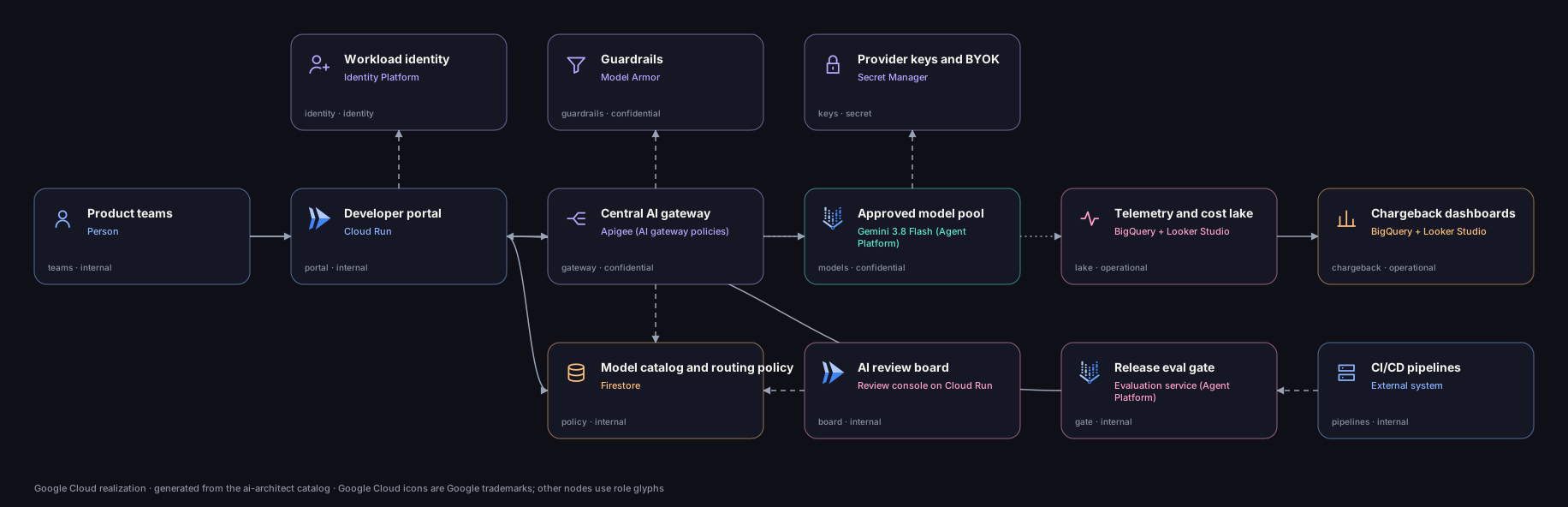
A shared platform sits in front of all model traffic. Product teams get approved models, keys and budgets through a portal; every call is routed, cached, scanned and attributed; releases pass an evaluation gate; finance sees cost per workload and per accepted result.
Google Cloud / primary provider
What carries each step.
Apigee policies enforce token quotas and routing; Model Armor screens prompts and responses; BigQuery holds the call lake for Looker Studio chargeback.
Data and model estate in one place: Gemini on Agent Platform, Agent Search and RAG Engine, AlloyDB and BigQuery, Cloud Run for everything else.
| Component | Service | Evidence |
|---|---|---|
| Person | ||
| Cloud Run | prior, ga | |
| Identity Platform | prior, ga | |
| Apigee (AI gateway policies) | prior, ga | |
| Model Armor | prior, ga | |
| Firestore | prior, ga | |
| Gemini 3.8 Flash (Agent Platform) | source, ga | |
| Secret Manager | prior, ga | |
| BigQuery + Looker Studio | prior, ga | |
| BigQuery + Looker Studio | prior, ga | |
| Evaluation service (Agent Platform) | confirm | |
| Review console on Cloud Run | prior, ga | |
| External system |
Customer view / judgement, not benchmark
Weigh what this customer values.
Remove providers that fail a hard constraint first: residency, data rights, identity estate, latency, operating owner, budget. Then weigh the rest. Scores are architect judgement on a 1-5 scale for the pattern as specified, recorded with a rationale. They are not benchmarks. A provider's consumption opportunity never changes a customer score.
Highest weighted: Vercel, 4.33 of 5.
Performance 5Time to value 5Speed to execution 5Cost per accepted result 4Exit cost 4Governance fit 3
Fastest path for teams already on Vercel; enterprise data-residency and audit needs confirmation.
Performance 5Time to value 4Speed to execution 4Cost per accepted result 5Exit cost 4Governance fit 4
Strong edge control plane at low cost; release gating is application work.
Performance 4Time to value 3Speed to execution 3Cost per accepted result 4Exit cost 4Governance fit 5
Enterprise-grade controls; Apigee configuration is a skill the platform team must hold.
Performance 4Time to value 4Speed to execution 3Cost per accepted result 4Exit cost 3Governance fit 5
Mature pattern on Azure; tier choice drives cost.
Performance 4Time to value 3Speed to execution 3Cost per accepted result 4Exit cost 3Governance fit 5
Native attribution for Bedrock traffic; non-AWS models need a separate gateway.
Performance 3Time to value 3Speed to execution 4Cost per accepted result 4Exit cost 5Governance fit 2
Portable and cheap; operational risk sits with your team.
Provider ledger / shown after the choice
What grows on Google Cloud.
These meters are the provider team’s consumption view. They explain the cloud workload; they never raise a customer score.
- Gemini input and output tokens
- Cloud Run vCPU-seconds and requests
- Agent Search queries and index storage
- AlloyDB or Cloud SQL instance hours
- BigQuery slots or bytes scanned
Take it with you / generated from one specification
Exact views, and a running start.
Google Cloud views
- SVG diagram for decks and documents
- diagrams.net file editable, shared IDs
- React Flow JSON for your own canvas
- Mermaid flowchart
Every provider
- Structurizr workspace C4 containers, one deployment view per provider
- Journey sequence (Mermaid)
One-click template
No Google Cloud template yet.
The same answer contract runs on these runtimes today; its conformance suite is the porting checklist.
- Vercel: anthropic/claude-sonnet-5.5 with gateway fallbacks
- Cloudflare: @cf/meta/llama-3.3-70b-instruct-fp8-fast
- Google Cloud: gemini-3.8-flash on the global endpoint
Customer ledger / assumptions you can move
Cost per accepted result.
Every attempt is charged, so failed runs count. Value comes only from accepted results. Illustrative assumption: tasks are workload releases per month; minutes saved are setup and review time per release. Model spend savings from caching and routing are a separate measured ledger.
Primary metric: Governed share of model traffic. Model calls routed through the plane with workload attribution, divided by all model calls observed on provider invoices.
- Monthly value
- €16,416
- Monthly cost
- €5,192
- Net
- €11,224
- Cost per accepted result
- €120
Experience / drawn from the specification
What the person sees, including no.
Screens are rendered from structured blocks in the catalog, so a refusal or an exception is designed before it happens. Values marked fixture are illustrations, not measurements.
| Workload | Models | Budget | Gate |
|---|---|---|---|
| support-agent | claude-sonnet-5, gemini-3.8-flash | EUR 3,000 | Pass |
| invoice-intake | gemini-3.8-flash | EUR 1,200 | Pass |
| sales-copilot | claude-sonnet-5 | EUR 2,500 | Blocked |
sales-copilot v1.8 blocked: citation precision 0.88 (gate 0.95).
- 12 failing cases attached
- Previous release remains live
support-agent reached 80 percent of its monthly model budget.
- Cache hit rate fell after the prompt change on Tuesday
- Fallback model handled 12 percent of calls
Team workflow / who carries what
Every lane leaves evidence.
| Lane | Responsibility | Evidence it leaves |
|---|---|---|
| Customer | Product team registers, ships, reads its cost and eval results | Workload record |
| AI | Models serve calls through the plane only | Routed-call share |
| System | Gateway enforces policy, budgets and guardrails | Blocked and redacted call log |
| Reviewer | Review board approves models and data classes | Decision records |
| Operator | Platform team and finance reconcile invoices against the lake monthly | Reconciliation report |
Release evaluations
What must pass before anyone ships.
Governed traffic share
>= 0.95 of invoiced model spend traced to a workload
Monthly reconciliation of the lake against provider invoices.
Gate coverage
100 percent of production AI releases ran the gate
Pipeline audit.
Guardrail false positives
<= 1 percent of benign calls blocked
Labelled benign traffic sample.
Gateway overhead
p95 added latency <= 30 ms
Synthetic load.
Risks and controls
What would go wrong first.
Teams call providers directly.
Provider keys exist only in the plane; egress rules; invoice reconciliation.
Gateway outage stops all AI features.
Multi-region deployment, fail-open policy per workload class, tested runbook.
Spend growth read as success.
Report cost per accepted result beside spend; provider consumption is a separate ledger.
Image recipes / concept art only
When to generate, and when never to.
16:9 · gpt-image-2 or a current Gemini image model
Customer moment for a proposal cover or portal hero.
Cinematic editorial photograph, late afternoon light, shallow depth of field. Let twenty product teams ship AI features fast while the company can answer what each one costs, which data it sends where, and whether it got worse. The moment just after the accepted result: A workload release that passed its evaluation gate, with its traffic attributed and inside its budget. Real workplace, restrained palette of deep navy, warm paper and one cobalt accent. Natural expressions, no screens facing the camera. Concept art only. Do not render product logos, cloud icons, UI text or architecture labels; compose exact labels from the specification in code.
3:2 · gpt-image-2 (consistent characters across panels)
Team workflow storyboard for a workshop or executive briefing.
Five-panel storyboard, clean ink line with flat colour, consistent characters across panels. Panels follow the lanes customer, ai, system, reviewer, operator: (1) Product team registers, ships, reads its cost and eval results (2) Models serve calls through the plane only (3) Gateway enforces policy, budgets and guardrails (4) Review board approves models and data classes (5) Platform team and finance reconcile invoices against the lake monthly Each panel shows hands and decisions, not screens. Concept art only. Do not render product logos, cloud icons, UI text or architecture labels; compose exact labels from the specification in code.
Do not generate
Any image a customer will read for component names, data classes or provider services.
Do not generate. Export the compiled view for the chosen provider. A generated architecture image can invent services, misspell names and draw icons the vendor never published.
A design, not a deployment: no realization on this page carries a provider receipt. Generated from the pattern source at revision c43825efda38. Apache-2.0 for catalog content and exports; provider names are trademarks of their owners; Google Cloud icons retain Google rights.
Next pattern: Document intake pipeline