A2 · Tool workflow · software, financial services, healthcare, education, retail
In-product copilot
Help inside the product, scoped to one tenant, metered to the cent.
- Customer job
- Get a task done in the product without leaving the screen or reading the docs.
- Today
- Users open support tickets or abandon the feature; the product team cannot price AI features because usage is not attributed.
- Accepted result
- A suggestion the user applies, inside their tenant, with cost attributed to that tenant.
A SaaS product embeds an assistant that answers from the tenant's own data and proposes typed, reversible actions the user confirms. Every call carries the tenant ID through retrieval, the model gateway and the usage meter, so isolation and billing are provable.
Google Cloud / primary provider
What carries each step.
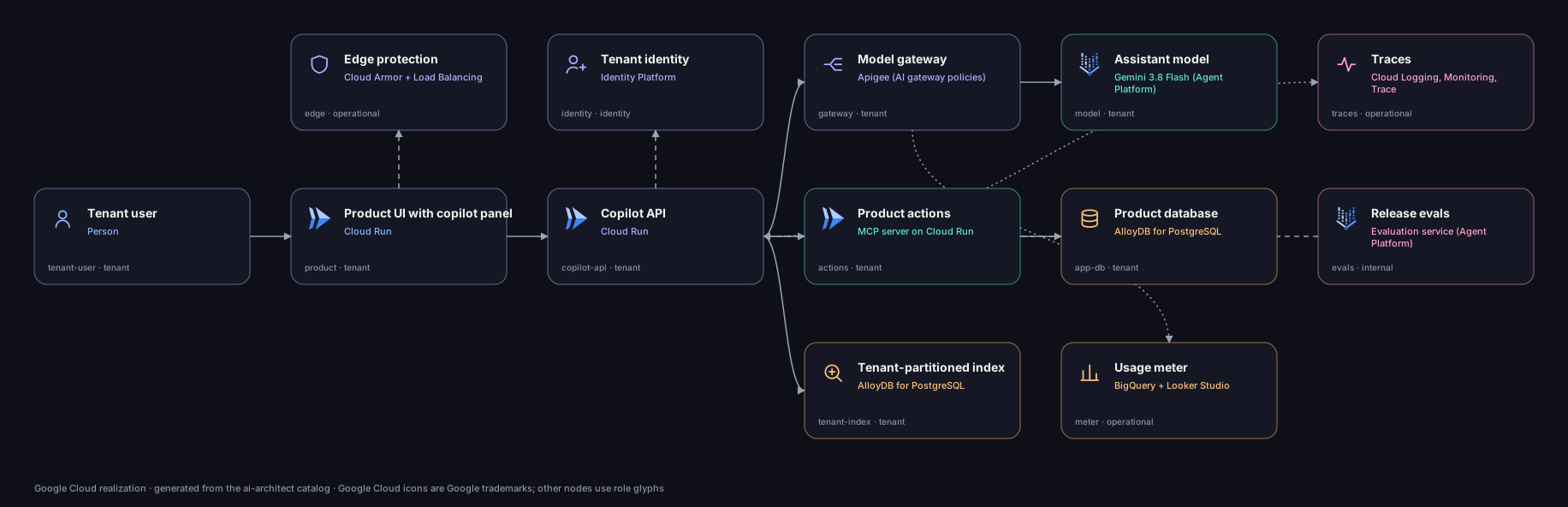
Keep vectors beside tenant rows in AlloyDB so row-level security applies to retrieval; meter through BigQuery exports.
Data and model estate in one place: Gemini on Agent Platform, Agent Search and RAG Engine, AlloyDB and BigQuery, Cloud Run for everything else.
| Component | Service | Evidence |
|---|---|---|
| Person | ||
| Cloud Run | prior, ga | |
| Cloud Armor + Load Balancing | prior, ga | |
| Identity Platform | prior, ga | |
| Cloud Run | prior, ga | |
| Apigee (AI gateway policies) | prior, ga | |
| Gemini 3.8 Flash (Agent Platform) | source, ga | |
| AlloyDB for PostgreSQL | prior, ga | |
| MCP server on Cloud Run | prior, ga | |
| AlloyDB for PostgreSQL | prior, ga | |
| BigQuery + Looker Studio | prior, ga | |
| Cloud Logging, Monitoring, Trace | prior, ga | |
| Evaluation service (Agent Platform) | confirm |
Customer view / judgement, not benchmark
Weigh what this customer values.
Remove providers that fail a hard constraint first: residency, data rights, identity estate, latency, operating owner, budget. Then weigh the rest. Scores are architect judgement on a 1-5 scale for the pattern as specified, recorded with a rationale. They are not benchmarks. A provider's consumption opportunity never changes a customer score.
Highest weighted: Vercel, 4.33 of 5.
Performance 5Time to value 5Speed to execution 5Cost per accepted result 4Exit cost 4Governance fit 3
The most direct fit for a Next.js SaaS; isolation proof is on the application team.
Performance 4Time to value 4Speed to execution 4Cost per accepted result 4Exit cost 4Governance fit 4
Database-enforced isolation; Postgres compatibility keeps exit cost moderate.
Performance 5Time to value 4Speed to execution 4Cost per accepted result 5Exit cost 3Governance fit 3
Isolation by construction at low cost; data residency per tenant needs design.
Performance 4Time to value 3Speed to execution 3Cost per accepted result 4Exit cost 4Governance fit 5
Strong cost attribution; more assembly.
Performance 4Time to value 4Speed to execution 4Cost per accepted result 4Exit cost 5Governance fit 2
Simple and portable; governance is entirely self-built.
Performance 4Time to value 3Speed to execution 3Cost per accepted result 3Exit cost 3Governance fit 5
Good governance; search units make many small tenants expensive.
Provider ledger / shown after the choice
What grows on Google Cloud.
These meters are the provider team’s consumption view. They explain the cloud workload; they never raise a customer score.
- Gemini input and output tokens
- Cloud Run vCPU-seconds and requests
- Agent Search queries and index storage
- AlloyDB or Cloud SQL instance hours
- BigQuery slots or bytes scanned
Take it with you / generated from one specification
Exact views, and a running start.
Google Cloud views
- SVG diagram for decks and documents
- diagrams.net file editable, shared IDs
- React Flow JSON for your own canvas
- Mermaid flowchart
Every provider
- Structurizr workspace C4 containers, one deployment view per provider
- Journey sequence (Mermaid)
One-click template / ai-architect-answer/v1
Grounded answers on Cloud Run with Gemini 3.8 Flash on Agent Platform
Model: gemini-3.8-flash on the global endpoint. Auth: Service account Application Default Credentials.
Evidence: local-tested: conformance suite, installed @google/genai client options and a local server run in fixture mode. Not yet verified: Container build, Cloud Run Button flow and a live Gemini call. The button builds from the engine’s main branch.
Customer ledger / assumptions you can move
Cost per accepted result.
Every attempt is charged, so failed runs count. Value comes only from accepted results. Illustrative assumption measured as user time saved; revenue from pricing the feature is a separate ledger.
Primary metric: Applied suggestions per active tenant. Suggestions applied without undo within 24 hours, per active tenant per week.
- Monthly value
- €38,500
- Monthly cost
- €3,850
- Net
- €34,650
- Cost per accepted result
- €0.40
Experience / drawn from the specification
What the person sees, including no.
Screens are rendered from structured blocks in the catalog, so a refusal or an exception is designed before it happens. Values marked fixture are illustrations, not measurements.
Why did churn rise in the DACH segment last month?
Three enterprise accounts in Germany cancelled after the price change on 1 September; they make up 71 percent of the rise. Fixture data.
Create 3 tasks in Retention board
- + Call Fabrikam GmbH owner
- + Offer annual plan to Northwind AG
- + Review pricing exception for Contoso DE
Summarise today's open invoices
12 open, 3 overdue (EUR 8,420). Fixture data.
Team workflow / who carries what
Every lane leaves evidence.
| Lane | Responsibility | Evidence it leaves |
|---|---|---|
| Customer | Ask, review the diff, confirm or undo | Apply and undo events |
| AI | Answer from tenant data; propose typed actions | Proposal with diff |
| System | Tenant scope, budgets, metering | Per-tenant usage export |
| Reviewer | Product manager reviews applied-versus-undone by feature | Weekly feature report |
| Operator | Finance prices the feature from metered cost | Cost per tenant |
Release evaluations
What must pass before anyone ships.
Cross-tenant leakage
0 responses containing another tenant's data
Seeded canary records per tenant; adversarial prompts.
Write confirmation
100 percent of writes preceded by confirmation
Action-layer audit in staging.
Applied suggestion rate
Tracked per feature; release blocks on a 20 percent drop
Product analytics.
First token
p95 <= 1.5 s
Gateway telemetry.
Risks and controls
What would go wrong first.
Data from one tenant appears for another.
Tenant from session only; namespaced index; tenant in cache key; canary probes.
One tenant consumes the AI budget.
Per-tenant budget at the gateway and plan-based limits.
Assistant changes data without consent.
Dry-run diff and confirmation enforced in the action layer.
Image recipes / concept art only
When to generate, and when never to.
16:9 · gpt-image-2 or a current Gemini image model
Customer moment for a proposal cover or portal hero.
Cinematic editorial photograph, late afternoon light, shallow depth of field. Get a task done in the product without leaving the screen or reading the docs. The moment just after the accepted result: A suggestion the user applies, inside their tenant, with cost attributed to that tenant. Real workplace, restrained palette of deep navy, warm paper and one cobalt accent. Natural expressions, no screens facing the camera. Concept art only. Do not render product logos, cloud icons, UI text or architecture labels; compose exact labels from the specification in code.
3:2 · gpt-image-2 (consistent characters across panels)
Team workflow storyboard for a workshop or executive briefing.
Five-panel storyboard, clean ink line with flat colour, consistent characters across panels. Panels follow the lanes customer, ai, system, reviewer, operator: (1) Ask, review the diff, confirm or undo (2) Answer from tenant data; propose typed actions (3) Tenant scope, budgets, metering (4) Product manager reviews applied-versus-undone by feature (5) Finance prices the feature from metered cost Each panel shows hands and decisions, not screens. Concept art only. Do not render product logos, cloud icons, UI text or architecture labels; compose exact labels from the specification in code.
Do not generate
Any image a customer will read for component names, data classes or provider services.
Do not generate. Export the compiled view for the chosen provider. A generated architecture image can invent services, misspell names and draw icons the vendor never published.
A design, not a deployment: no realization on this page carries a provider receipt. Generated from the pattern source at revision c43825efda38. Apache-2.0 for catalog content and exports; provider names are trademarks of their owners; Google Cloud icons retain Google rights.
Next pattern: Support resolution agent