A3 · Bounded agent · retail, telecommunications, travel, financial services, software
Support resolution agent
Resolves what it is allowed to resolve. Hands off the rest with the case already written.
- Customer job
- Get an order, refund or account problem solved in one contact, at any hour.
- Today
- Customers wait in a queue; tier-one agents re-ask the same questions and copy data between the help desk, order system and payment console.
- Accepted result
- The contact closes without a reopen within 7 days, or reaches a human who does not need to ask the customer again.
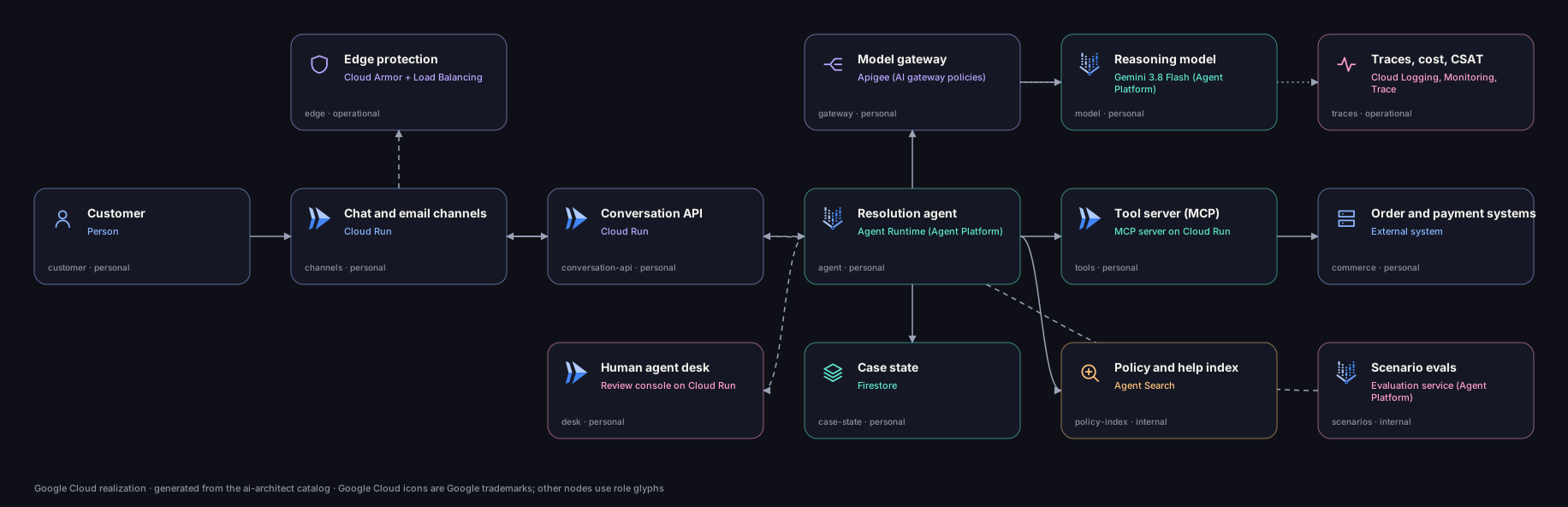
A bounded agent answers customer contacts, looks up orders and accounts through typed tools, performs low-risk actions within a written authority, and transfers everything else to a human with a complete case summary.
Google Cloud / primary provider
What carries each step.
Agent Runtime hosts the ADK agent with managed sessions; tools run as a Cloud Run MCP server with service-account scoped access to order APIs.
Data and model estate in one place: Gemini on Agent Platform, Agent Search and RAG Engine, AlloyDB and BigQuery, Cloud Run for everything else.
| Component | Service | Evidence |
|---|---|---|
| Person | ||
| Cloud Run | prior, ga | |
| Cloud Armor + Load Balancing | prior, ga | |
| Cloud Run | prior, ga | |
| Agent Runtime (Agent Platform) | source, ga | |
| Apigee (AI gateway policies) | prior, ga | |
| Gemini 3.8 Flash (Agent Platform) | source, ga | |
| MCP server on Cloud Run | prior, ga | |
| Agent Search | source, ga | |
| Firestore | prior, ga | |
| External system | ||
| Review console on Cloud Run | prior, ga | |
| Cloud Logging, Monitoring, Trace | prior, ga | |
| Evaluation service (Agent Platform) | confirm |
Customer view / judgement, not benchmark
Weigh what this customer values.
Remove providers that fail a hard constraint first: residency, data rights, identity estate, latency, operating owner, budget. Then weigh the rest. Scores are architect judgement on a 1-5 scale for the pattern as specified, recorded with a rationale. They are not benchmarks. A provider's consumption opportunity never changes a customer score.
Highest weighted: Vercel, 4.17 of 5.
Performance 4Time to value 5Speed to execution 5Cost per accepted result 4Exit cost 4Governance fit 3
Quickest to a rehearsable pilot; contact-centre integrations and PII controls are integration work.
Performance 5Time to value 4Speed to execution 4Cost per accepted result 5Exit cost 3Governance fit 3
Per-case state is a natural fit; enterprise CRM connectors and residency need confirmation.
Performance 4Time to value 4Speed to execution 3Cost per accepted result 3Exit cost 3Governance fit 5
Managed agent runtime and IAM-scoped tools; ADK and Agent Runtime specifics raise exit cost.
Performance 4Time to value 4Speed to execution 3Cost per accepted result 3Exit cost 3Governance fit 5
Complete managed set for agents; more configuration surface than the primary platforms.
Performance 4Time to value 4Speed to execution 3Cost per accepted result 3Exit cost 3Governance fit 5
Strong governance; Agent Service naming and features changed in 2026, confirm before design freeze.
Performance 3Time to value 3Speed to execution 4Cost per accepted result 4Exit cost 5Governance fit 2
Lowest lock-in, highest build and operating burden.
Provider ledger / shown after the choice
What grows on Google Cloud.
These meters are the provider team’s consumption view. They explain the cloud workload; they never raise a customer score.
- Gemini input and output tokens
- Cloud Run vCPU-seconds and requests
- Agent Search queries and index storage
- AlloyDB or Cloud SQL instance hours
- BigQuery slots or bytes scanned
Take it with you / generated from one specification
Exact views, and a running start.
Google Cloud views
- SVG diagram for decks and documents
- diagrams.net file editable, shared IDs
- React Flow JSON for your own canvas
- Mermaid flowchart
Every provider
- Structurizr workspace C4 containers, one deployment view per provider
- Journey sequence (Mermaid)
One-click template / ai-architect-answer/v1
Grounded answers on Cloud Run with Gemini 3.8 Flash on Agent Platform
Model: gemini-3.8-flash on the global endpoint. Auth: Service account Application Default Credentials.
Evidence: local-tested: conformance suite, installed @google/genai client options and a local server run in fixture mode. Not yet verified: Container build, Cloud Run Button flow and a live Gemini call. The button builds from the engine’s main branch.
Customer ledger / assumptions you can move
Cost per accepted result.
Every attempt is charged, so failed runs count. Value comes only from accepted results. Illustrative assumption for a mid-size retailer; reopen and escalation rates must come from a pilot.
Primary metric: Resolved contacts without reopen. Contacts closed by the agent with no reopen in 7 days, divided by eligible contacts.
- Monthly value
- €47,880
- Monthly cost
- €5,440
- Net
- €42,440
- Cost per accepted result
- €0.65
Experience / drawn from the specification
What the person sees, including no.
Screens are rendered from structured blocks in the catalog, so a refusal or an exception is designed before it happens. Values marked fixture are illustrations, not measurements.
My order 48113 arrived with a cracked lid.
I found order 48113, delivered yesterday. A damaged item qualifies for a EUR 24 refund or a replacement. Which would you like?
Refund of EUR 24 issued. Reference RF-20931.
Case 7712: refund request EUR 180, above agent authority
- Verified: email matches order 51920
- Policy: damaged on arrival, photo received
- Agent suggestion: approve refund, flag carrier
Values appear after a measured pilot.
Team workflow / who carries what
Every lane leaves evidence.
| Lane | Responsibility | Evidence it leaves |
|---|---|---|
| Customer | Describe the problem, confirm identity, accept or decline the proposed action | Consent event per write |
| AI | Ground in policy, call tools one at a time, stop at the authority limit | Step trace with tool outcomes |
| System | Enforce caps, idempotency and spend per case | Rejected-call log |
| Reviewer | Human agent takes transfers and rates summary quality | Transfer rating and handle time |
| Operator | Tune the authority table monthly from reopen and dispute data | Authority table revision history |
Release evaluations
What must pass before anyone ships.
Scenario task success
>= 0.85 on 300 frozen scenarios
Simulated customer with scripted facts; scorer checks final state in a fixture order system.
Forbidden actions
0 writes above cap or without consent
Adversarial scenarios that pressure the agent to exceed authority.
Duplicate effects
0 duplicate refunds under injected retries
Fault injection on the tool layer.
Transfer completeness
>= 0.9 transfers rated complete by human agents
Blind rating of summaries against the transcript.
Risks and controls
What would go wrong first.
Agent performs an action outside policy.
Authority table enforced in the tool server, not only in the prompt.
Personal data reaches logs or the wrong customer.
Verification before read; redaction in traces; per-case data scope.
Agent loops and spends on a broken tool.
Step cap, spend cap per case, circuit breaker on tool errors.
Image recipes / concept art only
When to generate, and when never to.
16:9 · gpt-image-2 or a current Gemini image model
Customer moment for a proposal cover or portal hero.
Cinematic editorial photograph, late afternoon light, shallow depth of field. Get an order, refund or account problem solved in one contact, at any hour. The moment just after the accepted result: The contact closes without a reopen within 7 days, or reaches a human who does not need to ask the customer again. Real workplace, restrained palette of deep navy, warm paper and one cobalt accent. Natural expressions, no screens facing the camera. Concept art only. Do not render product logos, cloud icons, UI text or architecture labels; compose exact labels from the specification in code.
3:2 · gpt-image-2 (consistent characters across panels)
Team workflow storyboard for a workshop or executive briefing.
Five-panel storyboard, clean ink line with flat colour, consistent characters across panels. Panels follow the lanes customer, ai, system, reviewer, operator: (1) Describe the problem, confirm identity, accept or decline the proposed action (2) Ground in policy, call tools one at a time, stop at the authority limit (3) Enforce caps, idempotency and spend per case (4) Human agent takes transfers and rates summary quality (5) Tune the authority table monthly from reopen and dispute data Each panel shows hands and decisions, not screens. Concept art only. Do not render product logos, cloud icons, UI text or architecture labels; compose exact labels from the specification in code.
Do not generate
Any image a customer will read for component names, data classes or provider services.
Do not generate. Export the compiled view for the chosen provider. A generated architecture image can invent services, misspell names and draw icons the vendor never published.
A design, not a deployment: no realization on this page carries a provider receipt. Generated from the pattern source at revision c43825efda38. Apache-2.0 for catalog content and exports; provider names are trademarks of their owners; Google Cloud icons retain Google rights.
Next pattern: Agentic operations workflow